Forest
Christina Lee: As an artist navigating between visual arts, installations, and spatial creation, how would you like readers to view this work, Forest?
Ting-jia Zhang: To discuss the origin of Forest, we must look back at my 2017 book, Any-object-whatever.
The focus of Any-object-whatever is actually discussing the material system constructed by dynamic ready-mades in our short lives. It can be seen as an introductory book that uses "life phenomena" to derive design principles. In the images of Any-object-whatever, readers can see my daily observations from 2014 to 2017. I intentionally condensed the design theory into a few pages in the first half of the book. On one hand, I wanted readers to focus on the results of urban observation and participation; on the other hand, I hoped they would take time later to appreciate the relationship between these phenomena and theories of art, images, and philosophy.
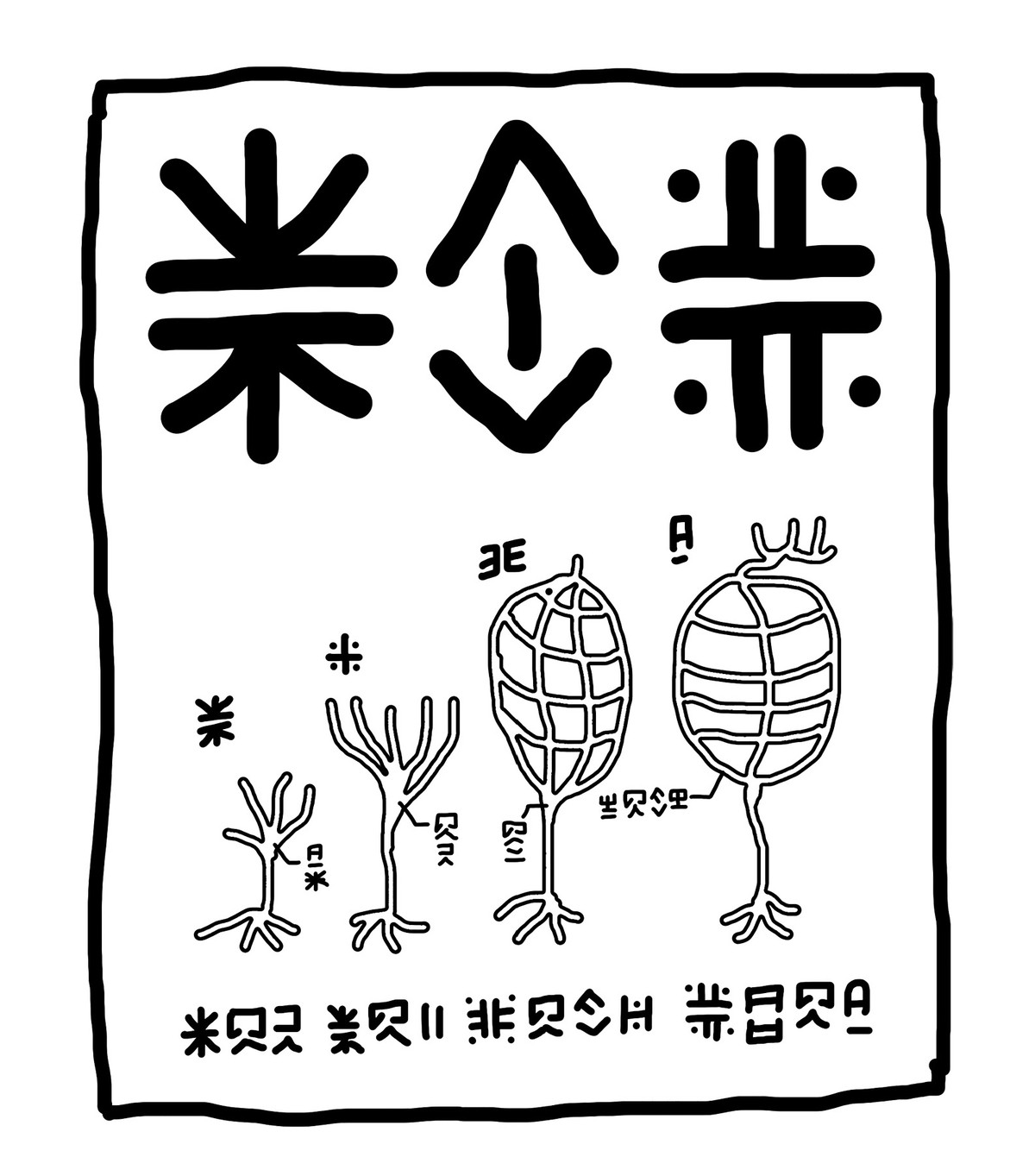
Forest is a full illustration book built on the principles explained in Any-object-whatever, but it does not explicitly write out those principles. While Any-object-whatever discusses how to extend a sense of unfamiliarity in a long-term residence, Forest directly presents viewers with an unfamiliar language and object system, allowing them to deduce the culture of this living group themselves.
Christina Lee: It is indeed rare to see your paintings again. As far as I know, after the Jia-Jia Universe project in 2018, you shifted towards spatial installations and interior design. What was the motivation for returning with a full illustration book this time?
Ting-jia Zhang: To be precise, I don't see it as a return, but rather a shift of painting techniques to other fields. When painting, we often envision the finished image, and brushes and pigments are the main media. When creating events or spatial objects, it is the same; we need to envision a specific image of the future space. The media to complete this image includes not just crafts but also communication with "people." So, it is formally a transition into the field of multimedia creation.
Returning to Forest, the part I visualized in advance was actually this introduction. I hoped to have a work that connects the past and the future, explaining my creative history and future plans.
Christina Lee: It sounds like the illustrations in Forest are not the main subject of this release. However, for readers, it is a beautiful work full of organic designs. How would you guide readers to understand this initial impression?
Ting-jia Zhang: Thank you for asking; that is a huge question. I will answer regarding the overall setting first. Returning to my persistence with "principles," the man-made objects in the book have clear language systems, structural systems, and design trends. We can also explore their etiquette, fashion, and trends. It is a "culture" we haven't explored yet. I set it in a country that exists in a timeline parallel to ours, with technology about ten years ahead of us.
Christina Lee: So it is not a fantasy work?
Ting-jia Zhang: Correct, it is not a fantasy work. To me, it is more like a textbook discussing the fundamentals of design.
Christina Lee: Honestly, I am a bit surprised it isn't fantasy. From what angle should I understand it as a textbook?
Ting-jia Zhang: I didn't use overly complex forms of expression in the book. You can clearly see the composition of buildings, the layout logic on advertising signs, and clothing pattern designs. It doesn't exceed the technical scope we can understand. Visually, compared to architectural design, I used more of the layout logic from 1960s Taiwan. This "Forest culture" faces future design trends just like we do, which can also be retro. I want to convey that, like us, they have a side of design full of human warmth.
Of course, once a work is completed, the author's interpretation is not authoritative. I am not worried if some people view it as a fantasy work. Even if you treat it as a diary, it doesn't affect the essence of viewing this book. I also enjoy watching interviews with other creators to observe how they understand themselves and how I understand their works.
Christina Lee: Yes, that is why I enjoy discussing your works with you, because you often share aspects that go beyond intuitive understanding. Recently, you have done a lot of work with a nature of "social service," such as interior design, graphic design, and even teaching. This is very different from the "you" I first knew. What was the turning point?
Ting-jia Zhang: Well, this is indeed a lesson life has given me. When I was young, I thought I would join the training for fine arts and become a signed artist. Having received fine arts enlightenment since childhood, I struggled during my studies. On one hand, I wanted to create; on the other hand, I wanted to be good at academics. Maybe I didn't decide early enough to bravely choose a path, or maybe I was greedy and wanted to balance both.
When I really had to choose, it was after graduating with my Master's degree. By then, my training in applied arts was sufficient, and I didn't feel I absolutely had to be a signed artist. Besides, investors betting on a "hybrid product" like me would have to be crazy, right? At that time, the concept of independent designers was very popular, so I found another entry point and joined in.
I was lucky to meet many manufacturers and clients as an independent designer. Often, after collaborating, clients revealed they had searched for my information beforehand. Since we both had practical experience with installations, the collaboration was very pleasant. I also found that clients inspired me greatly. When I formally entered the industry, I realized I was like a fresher with some basic skills: you can't work with cultural units without humility, and showing off circuit knowledge to clients with tech backgrounds is just showing off before an expert.
A major reason I am passionate about "social service" recently is that it involves participating in a "story" originating from others. To blend this story with myself, there must be friction, but this process promotes more interesting "writing." Especially during interviews after working with cultural or educational units, I feel my work is being interpreted in multiple ways. Such multiple interpretations are very healthy discussions for an artist or designer. If a work lets the public experience various aspects of life, doesn't it mean the progress of civilization has more possibilities?
Christina Lee: After hearing your understanding of social service, I seem to can categorize the position of Forest. Is it more like an intermediate work in your journey of social service, serving as a transitional annotation for the basic skills you applied during this period?
Ting-jia Zhang: Yes, that understanding fits my original intention perfectly. That is why I didn't interpret Forest through comics or a specific city. The reading experience is more like reading text symbols; readers get key images through the text and then construct their own exclusive understanding of the culture.
Christina Lee: The freedom in this setting is great; it is indeed like a non-linear novel or related essays. When I first opened Forest, I was curious about the cipher-like text. How should I understand the meaning behind this text design?
Ting-jia Zhang: The origin of language is still a discussed topic, especially for designers interested in typography; it is a systemic problem. In Forest, I don't intend to point to specific relationships between characters and meanings. Instead, I established initial principles as my main belief. I assume it is an East Asian country like ours, based on a language system derived from Traditional Chinese, and the Forest language emphasizes the "center structure" (Zhong-gong).
The character face is almost a perfect square rather than a rectangle. If understood through spatial perspective, I intentionally want it to be a perfect square single-vanishing-point system. This design brings a strong, direct, and hegemonic quality to the viewer. Most font designs also emphasize symmetry to handle this. This highlights the diverse nature of Forest culture. After all, if I used fonts with a lower center of gravity or non-rectangular shapes, they wouldn't form an interesting contrast with the organic lines of the man-made objects in Forest culture. This contrast is my personal judgment; I believe many designers emphasize harmony rather than contradictory contrast.
Christina Lee: Your thinking on language design is more rigorous than I imagined. This language type is one of the main reasons I initially thought it was fantasy. Can we talk about the organic man-made objects? Does Forest culture possess unique technology?
Ting-jia Zhang: The man-made objects drawn in Forest represent technology that human civilization can fully master in the near future. The hypothesis is simple: current designers mostly design for 3D entities. Imagine if we designed a plant from a product designer's perspective; we must add a time parameter to identify key growth nodes—what the seed looks like, what it looks like after ten days, after spreading leaves, and after aging. This is a romantic thing. We can now use video editing or animation to edit the key nodes of an image with a timeline, creating movies, YouTube, and Netflix. The progress of civilization makes human life richer. Forest just depicts one version of our life in the near future.
Christina Lee: I can understand better why it isn't fantasy now. After all, it depicts a future life close to our language system and applies classic design concepts. Forest seems to be an evolution of your college work Notes on Organic and Inorganic Objects. How do you view the relationship between Forest and Notes?
Ting-jia Zhang: If I refute your point about "evolution," you might find me annoying. Actually, the underlying knowledge behind all my works is the same. To me, "principles" are hard to innovate. Regarding the innovation of principles, perhaps we need to ask top philosophers or physicists. I am just re-arranging a new "phenomenon." Music is the same; I often hear top musicians understanding music theory and using new techniques—playing new tricks within the rhythm structure of 2/4, 3/4, or 4/4, or using sound, improvisation, narration, and emotion to dismantle the structure. It is the same in visual design or product design. So, the techniques applied in Forest and Notes are the same. Notes recorded a designer's daily thinking, while Forest refers to notes on man-made objects within a specific culture.
Christina Lee: You are not annoying. I like hearing creators explain their individual standpoints. Although misreading isn't a bad thing in contemporary reading, since we have this interview to guide readers, we should ask the author about the original design intention. I have a clear picture of the positioning and background of Forest now. My final personal question is: Do you expect a sequel to Forest? Or are you already planning one?
Ting-jia Zhang: Regarding a sequel to Forest, I am open-minded. There might be future collaborations. Publishing an illustration book is quite tiring. The main issue is that the principle behind it troubles me. As I said, every project has a knowledge system behind it—like Notes, Forest, and Any-object-whatever. Jia-Jia Universe discussed urban participation and the reproduction of memory. A collection of spatial design works will definitely happen; that is simpler. I believe there will be a book discussing the difference between contemporary craft and Forest, but not in the near future. I need to accumulate more physical works to give the reading more power. I still need to think more about the specific content of the next book.
Christina Lee: You really have great passion for creation. Finally, have you considered working with a publisher? Currently, most of your work is free to read or independently published like Forest. I am curious about your values regarding this.
Ting-jia Zhang: I honestly haven't thought about that. Maybe I am a control freak regarding creation. Also, a publisher would probably lose money on my stuff, right? I chose independent publishing for Forest mainly because having a physical copy feels real. I imagined it as a visual dictionary, reminding me of the encyclopedias I read as a child. The "warmth" of the work was a key factor in my recent decision.
Christina Lee: I see. It seems you are also very open regarding publishing. I hope today's interview design helps readers get into Forest more easily, and I look forward to readers finding their own exclusive understanding in Forest.
Ting-jia Zhang: Thank you, Christina. It is especially suitable to have you, someone who knows me well, conduct this interview. I look forward to more opportunities for collaboration in the future.
Christina Lee: As an artist navigating between visual arts, installations, and spatial creation, how would you like readers to view this work, Forest?
Ting-jia Zhang: To discuss the origin of Forest, we must look back at my 2017 book, Any-object-whatever.
The focus of Any-object-whatever is actually discussing the material system constructed by dynamic ready-mades in our short lives. It can be seen as an introductory book that uses "life phenomena" to derive design principles. In the images of Any-object-whatever, readers can see my daily observations from 2014 to 2017. I intentionally condensed the design theory into a few pages in the first half of the book. On one hand, I wanted readers to focus on the results of urban observation and participation; on the other hand, I hoped they would take time later to appreciate the relationship between these phenomena and theories of art, images, and philosophy.
Forest is a full illustration book built on the principles explained in Any-object-whatever, but it does not explicitly write out those principles. While Any-object-whatever discusses how to extend a sense of unfamiliarity in a long-term residence, Forest directly presents viewers with an unfamiliar language and object system, allowing them to deduce the culture of this living group themselves.
Christina Lee: It is indeed rare to see your paintings again. As far as I know, after the Jia-Jia Universe project in 2018, you shifted towards spatial installations and interior design. What was the motivation for returning with a full illustration book this time?
Ting-jia Zhang: To be precise, I don't see it as a return, but rather a shift of painting techniques to other fields. When painting, we often envision the finished image, and brushes and pigments are the main media. When creating events or spatial objects, it is the same; we need to envision a specific image of the future space. The media to complete this image includes not just crafts but also communication with "people." So, it is formally a transition into the field of multimedia creation.
Returning to Forest, the part I visualized in advance was actually this introduction. I hoped to have a work that connects the past and the future, explaining my creative history and future plans.
Christina Lee: It sounds like the illustrations in Forest are not the main subject of this release. However, for readers, it is a beautiful work full of organic designs. How would you guide readers to understand this initial impression?
Ting-jia Zhang: Thank you for asking; that is a huge question. I will answer regarding the overall setting first. Returning to my persistence with "principles," the man-made objects in the book have clear language systems, structural systems, and design trends. We can also explore their etiquette, fashion, and trends. It is a "culture" we haven't explored yet. I set it in a country that exists in a timeline parallel to ours, with technology about ten years ahead of us.
Christina Lee: So it is not a fantasy work?
Ting-jia Zhang: Correct, it is not a fantasy work. To me, it is more like a textbook discussing the fundamentals of design.
Christina Lee: Honestly, I am a bit surprised it isn't fantasy. From what angle should I understand it as a textbook?
Ting-jia Zhang: I didn't use overly complex forms of expression in the book. You can clearly see the composition of buildings, the layout logic on advertising signs, and clothing pattern designs. It doesn't exceed the technical scope we can understand. Visually, compared to architectural design, I used more of the layout logic from 1960s Taiwan. This "Forest culture" faces future design trends just like we do, which can also be retro. I want to convey that, like us, they have a side of design full of human warmth.
Of course, once a work is completed, the author's interpretation is not authoritative. I am not worried if some people view it as a fantasy work. Even if you treat it as a diary, it doesn't affect the essence of viewing this book. I also enjoy watching interviews with other creators to observe how they understand themselves and how I understand their works.
Christina Lee: Yes, that is why I enjoy discussing your works with you, because you often share aspects that go beyond intuitive understanding. Recently, you have done a lot of work with a nature of "social service," such as interior design, graphic design, and even teaching. This is very different from the "you" I first knew. What was the turning point?
Ting-jia Zhang: Well, this is indeed a lesson life has given me. When I was young, I thought I would join the training for fine arts and become a signed artist. Having received fine arts enlightenment since childhood, I struggled during my studies. On one hand, I wanted to create; on the other hand, I wanted to be good at academics. Maybe I didn't decide early enough to bravely choose a path, or maybe I was greedy and wanted to balance both.
When I really had to choose, it was after graduating with my Master's degree. By then, my training in applied arts was sufficient, and I didn't feel I absolutely had to be a signed artist. Besides, investors betting on a "hybrid product" like me would have to be crazy, right? At that time, the concept of independent designers was very popular, so I found another entry point and joined in.
I was lucky to meet many manufacturers and clients as an independent designer. Often, after collaborating, clients revealed they had searched for my information beforehand. Since we both had practical experience with installations, the collaboration was very pleasant. I also found that clients inspired me greatly. When I formally entered the industry, I realized I was like a fresher with some basic skills: you can't work with cultural units without humility, and showing off circuit knowledge to clients with tech backgrounds is just showing off before an expert.
A major reason I am passionate about "social service" recently is that it involves participating in a "story" originating from others. To blend this story with myself, there must be friction, but this process promotes more interesting "writing." Especially during interviews after working with cultural or educational units, I feel my work is being interpreted in multiple ways. Such multiple interpretations are very healthy discussions for an artist or designer. If a work lets the public experience various aspects of life, doesn't it mean the progress of civilization has more possibilities?
Christina Lee: After hearing your understanding of social service, I seem to can categorize the position of Forest. Is it more like an intermediate work in your journey of social service, serving as a transitional annotation for the basic skills you applied during this period?
Ting-jia Zhang: Yes, that understanding fits my original intention perfectly. That is why I didn't interpret Forest through comics or a specific city. The reading experience is more like reading text symbols; readers get key images through the text and then construct their own exclusive understanding of the culture.
Christina Lee: The freedom in this setting is great; it is indeed like a non-linear novel or related essays. When I first opened Forest, I was curious about the cipher-like text. How should I understand the meaning behind this text design?
Ting-jia Zhang: The origin of language is still a discussed topic, especially for designers interested in typography; it is a systemic problem. In Forest, I don't intend to point to specific relationships between characters and meanings. Instead, I established initial principles as my main belief. I assume it is an East Asian country like ours, based on a language system derived from Traditional Chinese, and the Forest language emphasizes the "center structure" (Zhong-gong).
The character face is almost a perfect square rather than a rectangle. If understood through spatial perspective, I intentionally want it to be a perfect square single-vanishing-point system. This design brings a strong, direct, and hegemonic quality to the viewer. Most font designs also emphasize symmetry to handle this. This highlights the diverse nature of Forest culture. After all, if I used fonts with a lower center of gravity or non-rectangular shapes, they wouldn't form an interesting contrast with the organic lines of the man-made objects in Forest culture. This contrast is my personal judgment; I believe many designers emphasize harmony rather than contradictory contrast.
Christina Lee: Your thinking on language design is more rigorous than I imagined. This language type is one of the main reasons I initially thought it was fantasy. Can we talk about the organic man-made objects? Does Forest culture possess unique technology?
Ting-jia Zhang: The man-made objects drawn in Forest represent technology that human civilization can fully master in the near future. The hypothesis is simple: current designers mostly design for 3D entities. Imagine if we designed a plant from a product designer's perspective; we must add a time parameter to identify key growth nodes—what the seed looks like, what it looks like after ten days, after spreading leaves, and after aging. This is a romantic thing. We can now use video editing or animation to edit the key nodes of an image with a timeline, creating movies, YouTube, and Netflix. The progress of civilization makes human life richer. Forest just depicts one version of our life in the near future.
Christina Lee: I can understand better why it isn't fantasy now. After all, it depicts a future life close to our language system and applies classic design concepts. Forest seems to be an evolution of your college work Notes on Organic and Inorganic Objects. How do you view the relationship between Forest and Notes?
Ting-jia Zhang: If I refute your point about "evolution," you might find me annoying. Actually, the underlying knowledge behind all my works is the same. To me, "principles" are hard to innovate. Regarding the innovation of principles, perhaps we need to ask top philosophers or physicists. I am just re-arranging a new "phenomenon." Music is the same; I often hear top musicians understanding music theory and using new techniques—playing new tricks within the rhythm structure of 2/4, 3/4, or 4/4, or using sound, improvisation, narration, and emotion to dismantle the structure. It is the same in visual design or product design. So, the techniques applied in Forest and Notes are the same. Notes recorded a designer's daily thinking, while Forest refers to notes on man-made objects within a specific culture.
Christina Lee: You are not annoying. I like hearing creators explain their individual standpoints. Although misreading isn't a bad thing in contemporary reading, since we have this interview to guide readers, we should ask the author about the original design intention. I have a clear picture of the positioning and background of Forest now. My final personal question is: Do you expect a sequel to Forest? Or are you already planning one?
Ting-jia Zhang: Regarding a sequel to Forest, I am open-minded. There might be future collaborations. Publishing an illustration book is quite tiring. The main issue is that the principle behind it troubles me. As I said, every project has a knowledge system behind it—like Notes, Forest, and Any-object-whatever. Jia-Jia Universe discussed urban participation and the reproduction of memory. A collection of spatial design works will definitely happen; that is simpler. I believe there will be a book discussing the difference between contemporary craft and Forest, but not in the near future. I need to accumulate more physical works to give the reading more power. I still need to think more about the specific content of the next book.
Christina Lee: You really have great passion for creation. Finally, have you considered working with a publisher? Currently, most of your work is free to read or independently published like Forest. I am curious about your values regarding this.
Ting-jia Zhang: I honestly haven't thought about that. Maybe I am a control freak regarding creation. Also, a publisher would probably lose money on my stuff, right? I chose independent publishing for Forest mainly because having a physical copy feels real. I imagined it as a visual dictionary, reminding me of the encyclopedias I read as a child. The "warmth" of the work was a key factor in my recent decision.
Christina Lee: I see. It seems you are also very open regarding publishing. I hope today's interview design helps readers get into Forest more easily, and I look forward to readers finding their own exclusive understanding in Forest.
Ting-jia Zhang: Thank you, Christina. It is especially suitable to have you, someone who knows me well, conduct this interview. I look forward to more opportunities for collaboration in the future.